

Fossils from the Oil Shale Formation
Unique Fossils from Holzmaden and Dotternhausen
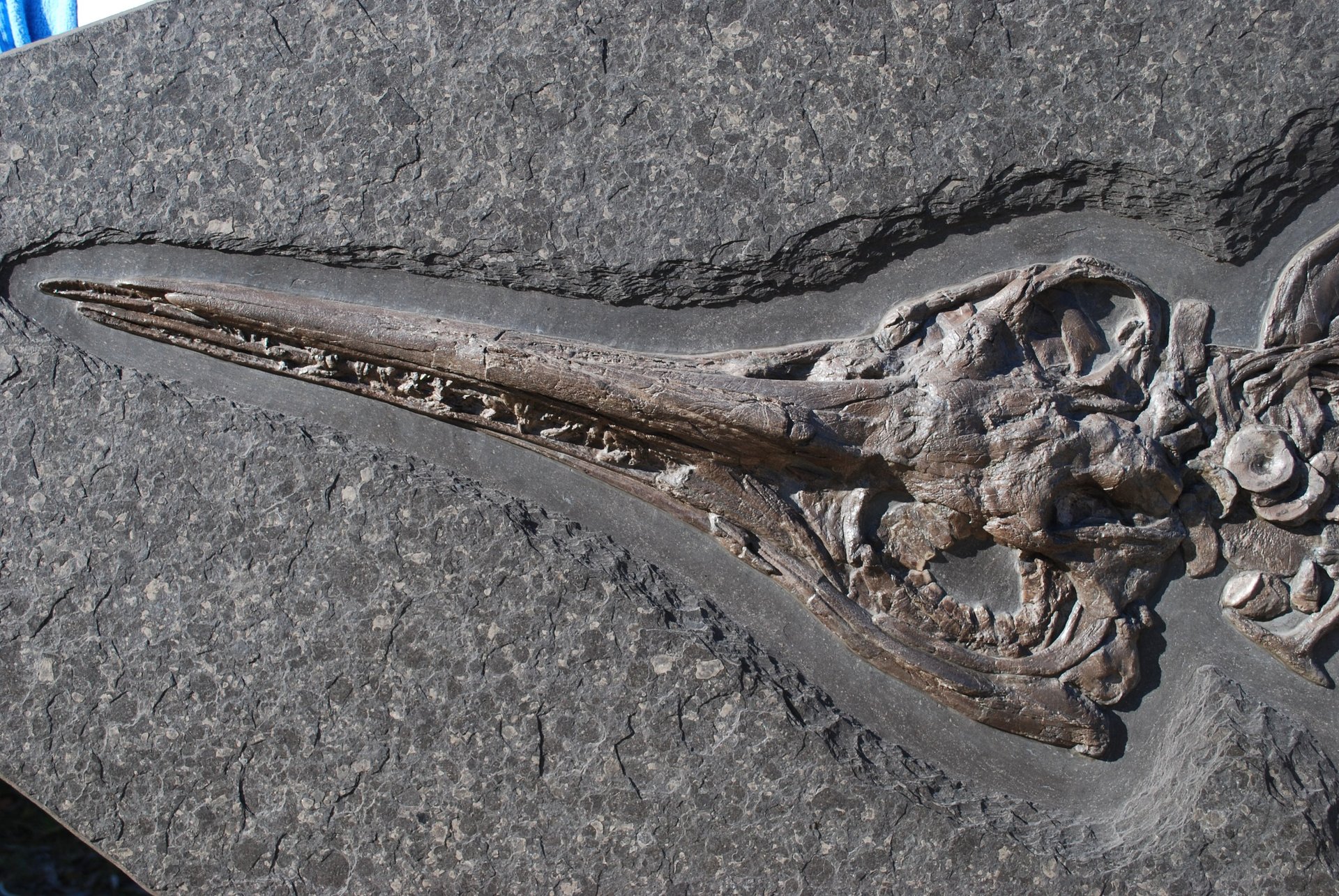
The Posidonia Shale of the South German Jurassic is one of the most important fossil Lagerstätten of the Lower Jurassic in Europe. The dark, bituminous clay and marlstones formed around 180 million years ago during the Early Jurassic in a largely enclosed marine basin at the margin of the former European shelf. Repeated oxygen-depleted conditions at the seafloor meant that dead organisms were scarcely decomposed by scavengers or bacteria and were rapidly buried in fine sediment.
These exceptional depositional conditions led to remarkably detailed fossil preservation. In addition to fully articulated skeletons of marine reptiles, delicate structures such as skin outlines, stomach contents, and even ichthyosaur embryos are frequently found.
The formation is especially famous for spectacular finds of marine reptiles such as ichthyosaurs and plesiosaurs, offering unique insights into the life of Jurassic oceans. Numerous fish species, ammonites, belemnites, and various crustaceans are also commonly present. Particularly characteristic are finely preserved crinoid colonies as well as remains of cephalopods, whose soft tissues were preserved under favorable conditions.
Important fossil sites are located around Holzmaden and Dotternhausen, as well as other outcrops of the Swabian Alb. Although belonging to the same geological formation, these localities can differ significantly in fossil abundance and composition.
As a result, the Lower Jurassic oil shale is of great importance for the study of early marine ecosystems worldwide. At the same time, it represents an outstanding source of scientifically significant fossils highly valued by museums around the world.
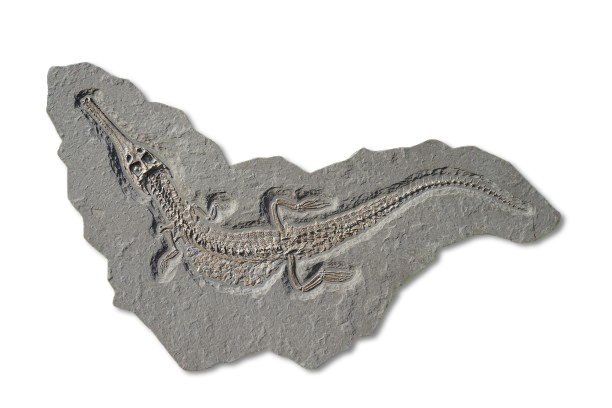
Marine Crocodile Steneosaurus bollensis
Complete marine crocodile of the species Steneosaurus bollensis from the Lower Jurassic of the classic fossil locality Holzmaden in Baden-Württemberg. On the back of the slab, there is a custom-made steel frame with a mounting system for easy wall display. This specimen has already been sold – please contact us if you are interested in a similar or comparable piece. The so-called Posidonia Shale from the Holzmaden area achieved worldwide fame due to its exceptionally well-preserved fossils. These deposits were formed around 190 million years ago during the Lower Jurassic, also known as the Lias or “Black Jurassic.” Typical fossils from the Posidonia Shale include, above all, the abundant ammonites found in almost all layers, such as genera Dactylioceras, Hildoceras, Harpoceras, Phylloceras, and Lytoceras. From time to time, spectacularly well-preserved crinoids, fish, ichthyosaurs, and more rarely marine crocodiles, and in exceptional cases even pterosaurs, are discovered in outstanding preservation. Such fossils from the Holzmaden area can be admired in almost all major natural history museums worldwide, including the museums Fischer and Hauff in Holzmaden, the natural history museums in Stuttgart, Karlsruhe, Munich, and Salzburg, the Holcim visitor center in Dotternhausen, as well as the Houston Museum of Natural Science and many other institutions around the world.
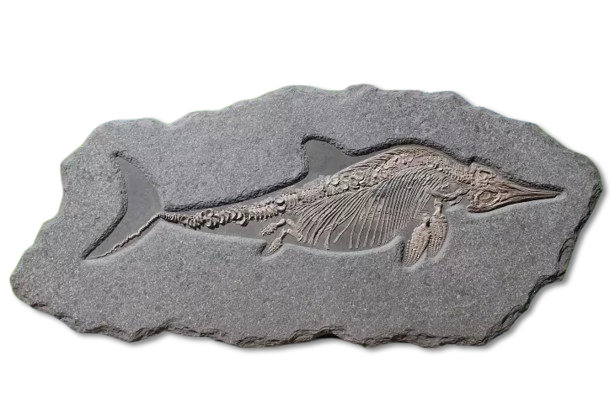
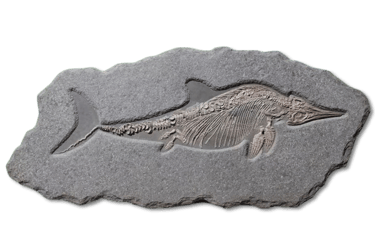
Exceptionally well-preserved Ichthyosaur
Complete fossil of an ichthyosaur (Stenopterygius sp.) in excellent preservation from the Lower Jurassic of the classic fossil locality Holzmaden in Baden-Württemberg. On the back of the slab, there is a custom-made steel frame with a mounting system for easy wall display. This specimen is available for purchase – please contact us if you are interested in this or a similar piece. The so-called Posidonia Shale from the Holzmaden area achieved worldwide fame due to its exceptional fossil discoveries. These deposits were formed around 190 million years ago during the Lower Jurassic, also known as the Lias or “Black Jurassic.” Typical fossils from the Posidonia Shale include, above all, the abundant ammonites found in almost all layers, such as the genera Dactylioceras, Hildoceras, Harpoceras, Phylloceras, and Lytoceras. From time to time, spectacularly well-preserved crinoids, fish, ichthyosaurs, and more rarely marine crocodiles, and in exceptional cases even pterosaurs, are discovered in outstanding preservation. Such fossils from the Holzmaden area can be admired in almost all major natural history museums worldwide, including the museums Fischer and Hauff in Holzmaden, the natural history museums in Stuttgart, Karlsruhe, Munich, and Salzburg, the Holcim visitor center in Dotternhausen, as well as the Houston Museum of Natural Science and many other institutions worldwide.
This fossil has already been sold.
This fossil has already been sold.
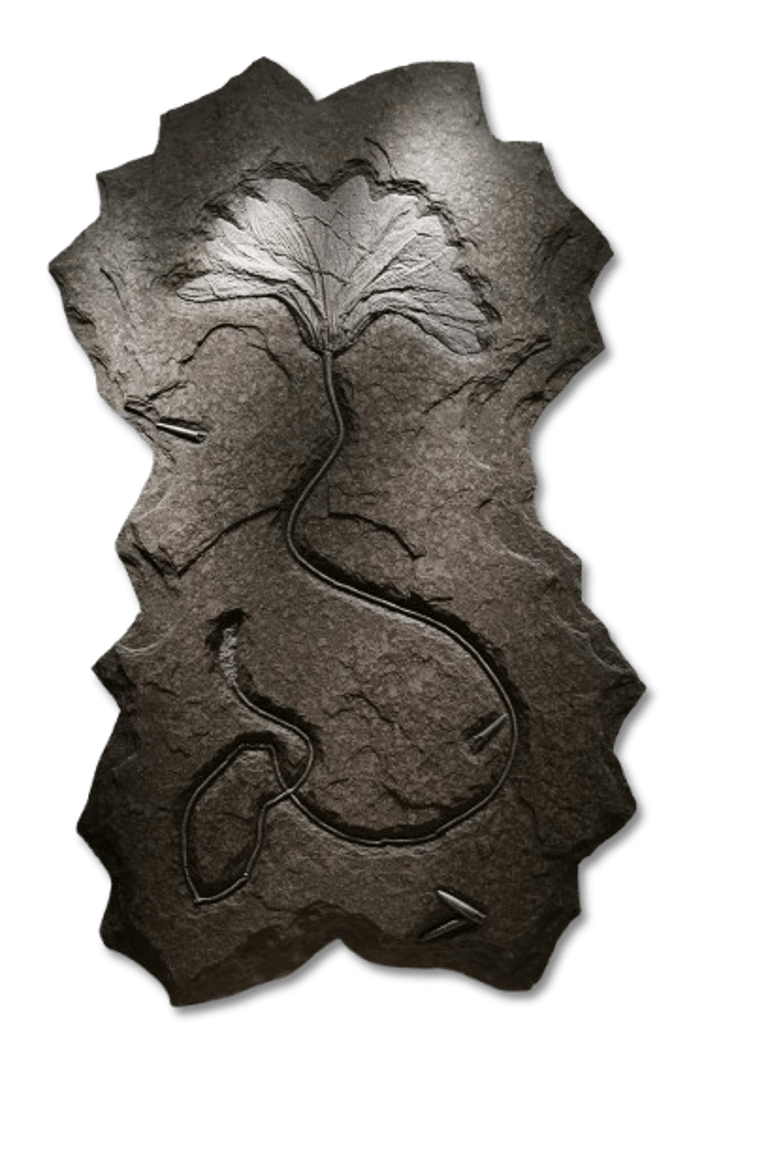
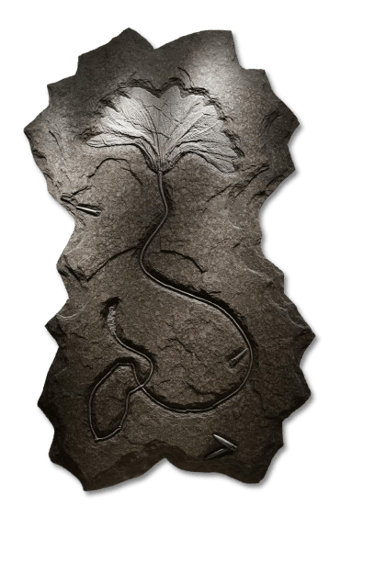
Large Crinoid Seirocrinus subangularis
This fossil has already been sold.
Exceptionally large sea lily of the species Seirocrinus subangularis from the Lower Jurassic/Toarcian (Lias epsilon 2) of the classic fossil locality Holzmaden in Baden-Württemberg. This slab measures approximately 180 cm × 110 cm, and the calyx has a diameter of about 59 cm. On the back of the slab, there is a custom-made steel frame with a mounting system for easy wall display. This piece has already been sold — please feel free to contact us if you are interested in a similar specimen. The so-called Posidonia Shale from the Holzmaden area achieved worldwide fame due to its exceptional fossil discoveries. These deposits were formed around 190 million years ago during the Lower Jurassic, also known as the Lias or “Black Jurassic.” Typical fossils from the Posidonia Shale include, above all, the abundant ammonites found in almost all layers, such as Dactylioceras, Hildoceras, Harpoceras, Phylloceras, and Lytoceras. From time to time, spectacularly well-preserved crinoids, fish, ichthyosaurs, and more rarely marine crocodiles, and in exceptional cases even pterosaurs, are discovered in outstanding preservation. Such fossils from the Holzmaden area can be admired in almost all major natural history museums worldwide, including the museums Fischer and Hauff in Holzmaden, the natural history museums in Stuttgart, Karlsruhe, Munich, and Salzburg, the Holcim visitor center in Dotternhausen, as well as the Houston Museum of Natural Science and many other institutions worldwide.
Contact
If you are interested or would like to know the price of a comparable specimen? Simply leave your contact details here and we will get back to you as soon as possible.
Contact
Eurofossils
Dr. Martin Görlich
Tel: +49 (0) 171 – 894 21 84
Email: eurofossils@web.de
Copyright © 2026 eurofossils